Fighting Earps of San Bernardino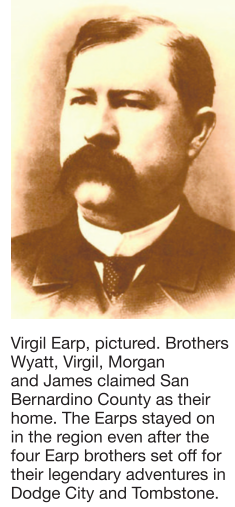
Foothills History
 The history of the Old West is populated by rugged individual lawmen such as Pat Garrett, Bill Tilghman or Heck Thomas, while outlaw families such as the James, Youngers or Daltons were often the rule.
That mold was broken with the most famous family of lawmen in American history – the “Fighting Earps” consisting of brothers Wyatt, Virgil, Morgan and James, who claimed San Bernardino County as their home.
The Earps used their badges to facilitate lucrative gambling enterprises, yet playing both sides of the fence was a family tradition. Their father, Nicholas Porter Earp, lost his job as a lawman when his role as a bootlegger was exposed to his pious Iowa neighbors.
The Earps came to San Bernardino from Iowa in December 1864 and set up their first camp near today’s county court
building on Sierra Way and Court Street – known as ‘Whiskey Point’
because saloons stood on each corner of the intersection.
They rented a ranch on the banks of the Santa Ana River in northern Redlands and moved to another on Mission Road in Loma Linda.
Over
time, the Earp clan grew to be instrumental in the growth of the
region, serving as police officers, farmers, businessmen and detectives.
After
a critically wounded Virgil returned the murdered body of brother
Morgan to Colton after the legendary gunfight at the OK Corral, he
stayed on in Colton with his father, who was by then a prominent and
prosperous community leader who served as justice of the peace.
Even
Wyatt, the brother most affected by wanderlust, “spent more of his life
in San Bernardino County, California, than anywhere else” according to
The Earp Clan: The Southern California Years author Nicholas R. Cataldo.
In fact, Wyatt’s last commission as a lawman was as a non-salaried San
Bernardino County deputy.
Save
for a brief return to the Midwest in 1868, the Earps stayed on in the
region even after the four Earp brothers set off for their legendary
adventures in Dodge City and Tombstone. Nicholas lived the rest of his
life in Colton until he moved to the Soldier’s Home in Sawtelle, where
he survived all but four of his 11 children and two of his three wives.