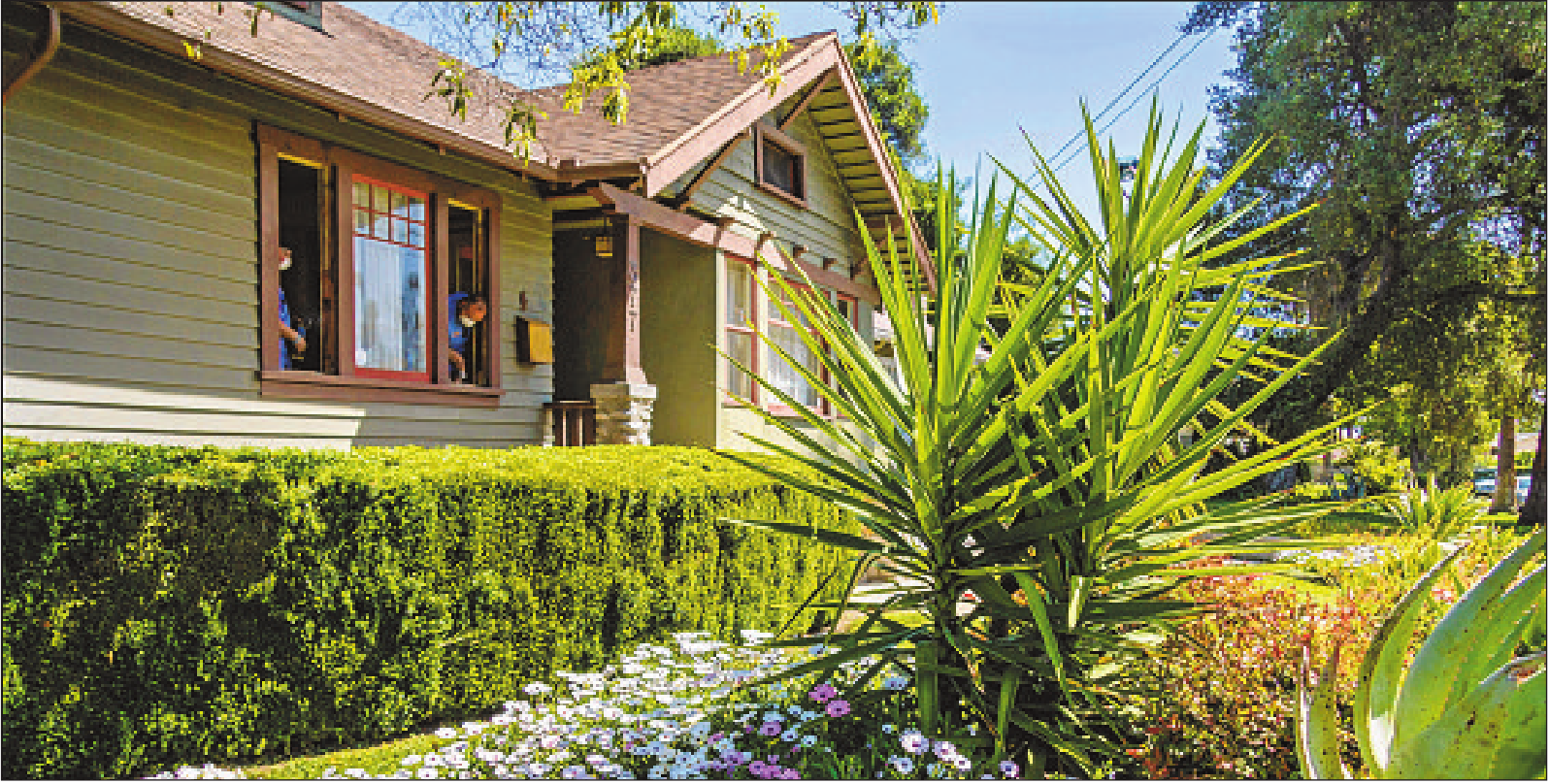
Even century-old ones can operate like new with proper attention.
Consider the historic doublehung window: two sashes glide effortlessly up and down, counterbalanced by iron weights attached to ropes strung through pulleys –– all hidden within walls.
“As the weights touch, they get abit musical and there’s a kind of harmonic ring in your wall,” said Steve Byroads, owner of Silver Lake-based Dr. Door and Window. “It’s like the house is alive.”
But with soulful age come other sounds: rattles, wind whistling through gaps and a homeowner’s curses because the blasted contraptions won’t open and close properly. Byroads and other master carpenters specialize in repairing historic wood windows to avoid the torment of every preservationist: vinyl replacement windows.
Most established windowrepair shops specialize in tuning up or replicating double-hung windows, many with the old rope, pulley and weight system (springloaded balancers appeared in the late 1920s). They also repair casement and older steel windows, but less commonly.
“It’s a terrible shame –– ripping out 100-year-old windows that need some attention, and replacing them with vinyls that last about 15 years,” said Scott Campbell, owner of Los Alamitos-based Window Restoration & Repair, opened in 2000.

Besides a shorter life span, vinyl replacement windows often don’t match older homes’ historical features, the men said. And depending on the property or the neighborhood, historic guidelines might forbid them.
Some
homeowners cite energy conservation as a reason to replace historic
windows; energyefficient windows have panes filled with inert gases to
block heat and cold. It’s an argument that Byroads and Campbell don’t
wholly buy.
“Old wood
windows can be tightened up so they seat and seal well; they can
approach the efficiency of modern windows,” said Campbell, adding that
any cost savings is “negligible on a power bill.”
As a compromise, Byroads said new custom-milled sashes can be fitted with energy-efficient glass that mimics originals.
Earlier this year, Campbell repaired 17 original double-hung windows that grace a 1907 Pasadena Craftsman bungalow.
“They were very drafty,
painted shut, and only three would open –– and those had to be propped
open with sticks,” said homeowner Michael e. Stern, who bought the home
in 2006.
After removing the sashes, joints were tightened, sash cords replaced and weatherstripping added, among other fixes.
“Our
house is noticeably more quiet, less drafty and also more efficient in
terms of air conditioning,” said Stern, 62, a photographer and
filmmaker.
Double-hung
windows were, in fact, a way to air condition homes acentury ago. Top
window sashes open to let warm air out, and lower windows allow cooler
air to stream in.
“You get a nice flow of air through the house,” Stern said. “You can control the inside temperature more than you realize.”
Byroads’
and Campbell’s restored double-hung windows always get the “two finger
test,” the ease with which windows open and close when pushed by two
fingers.
Campbell
charges $275 to $300 per window for tune-ups, similar to the work done
for Stern. And because old homes settle and slump, sashes are sometimes
planed to fit skewed frames. He charges from $500 to $1,000 to replace
windows with custombuilt equivalents.
Byroads,
who opened his shop in 1989, charges from $125 to $275 per window for
basic tune-ups, and up to $625 for more extensive work.
Homeowners who forgo such repairs sometimes opt for inventive fixes.
“We’ve
seen every variety of a Band-Aid used on windows to close up gaps ––
including, literally, Band-Aids,” said Campbell, who heads a staff of
14.
Broken window
glass requires a more secure mend. Even with this fix, there’s an artful
solution: The distinctive imperfections found in vintage glass ––
ripples, lines and small bubbles –– can be partly replicated.
Those
now-prized defects were caused by machine-drawn cylinder glass, the
early 20th century production method that, given its numerous steps of
drawing glass from circular tanks and then flattening it, made for
flaws.
“Today, glass
can be mechanically wiggled as it’s being made –– it produces the same
sort of imperfections,” Campbell said –– except for those winsome
bubbles.
hotproperty@latimes.com