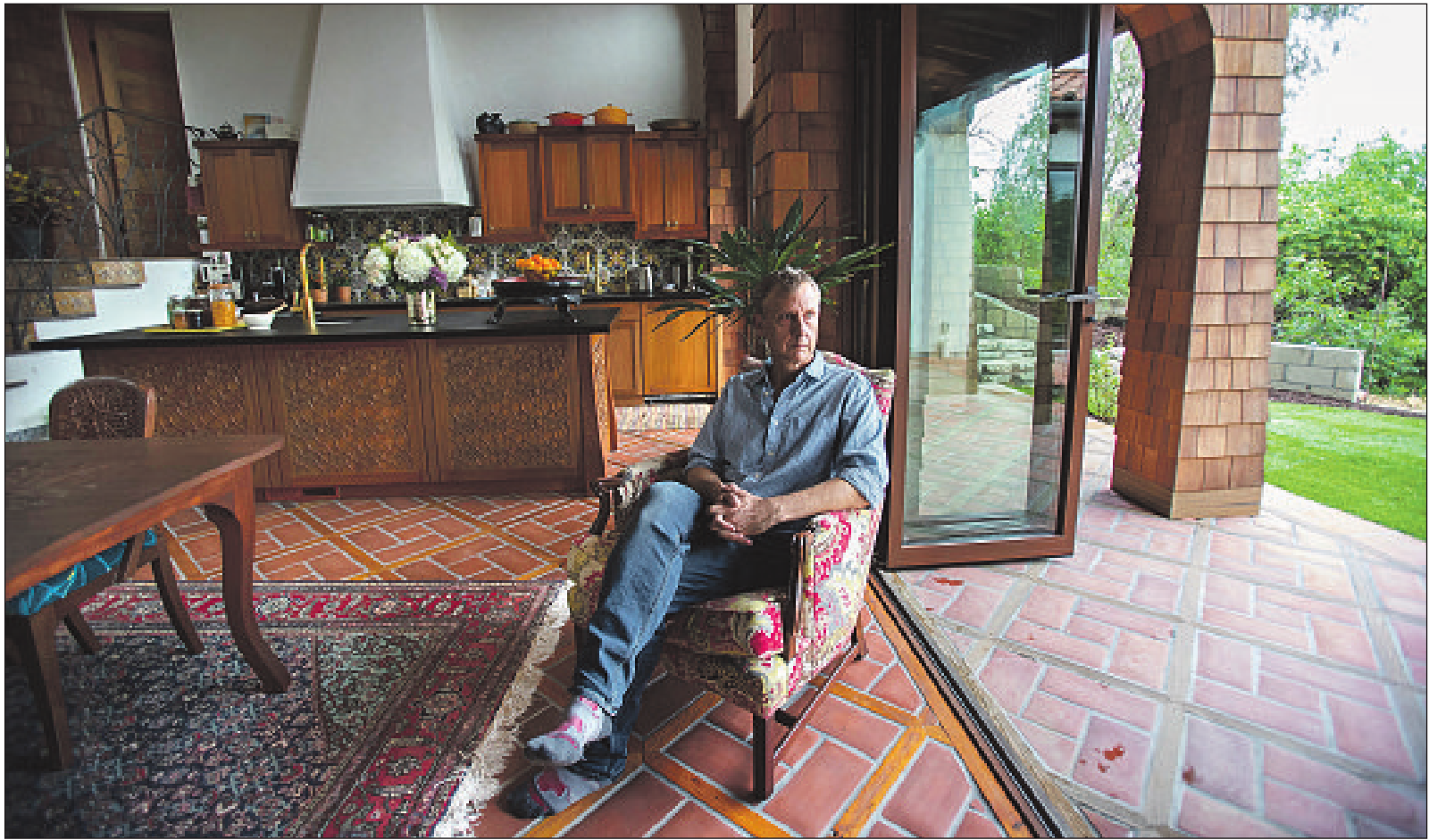
A designer’s home is the model for building with a smaller carbon footprint.
Eco-sensitive designers and builders have long used salvaged lumber or recycled fixtures. Steve Pallrand, founder and principal designer of L.A. firm Home Front Build, is pushing even further in his quest for zero net energy, drawing inspiration from smart designs of yesteryear, and our microscopic neighbors.
His CarbonShack initiative, to create green homes that preserve both the environment and residents’ quality of life, started with his own 2,495-square-foot Mount Washington home as the prototype.
Instead of just focusing on operational energy savers, such as solar panels or innovative heating equipment, Pallrand said he wants CarbonShack to shift its aim to “all aspects of efficiency,” and the actual way we construct our homes — “the carbon cost of the structure itself, called the embodied energy.”
Pallrand and his team turned to the design of the home itself, thick insulation, airtight windows and salvaged materials.
They even altered the composition of the concrete used in the project to make it more carbon neutral, noting on their website that concrete production alone accounts for 5% to 8% of global carbon dioxide emissions.
The firm uses “beautiful, old, viable lumber, deconstructed and rebuilt within the city to reduce the carbon footprint,” said Pallrand, whose own home is made of roughly 75% salvaged material including a local Craftsman house whose timber was headed for the dump.
“We took a house apart that was built in 1915 and framed and built it into a house in 2017,” he said.
Wood cabinets were salvaged from old church pews made out of Philippine mahogany imported in the 1920s, while the kitchen uppers and master bedroom’s redwood paneling came from a decommissioned bridge in Humboldt County that Pallrand bought and demoed four years ago.
“There
are nail holes in the wood with blackness around from the oxidization
of the iron. We leave it in because it adds character to this gorgeous,
dense, tightgrain redwood,” Pallrand said.
Long
before CarbonShack, Home Front Build already used repurposed wood on
restorations or additions to historic properties. One example, a Los
Feliz Spanish Colonial remodel and addition, seamlessly connected the
new kitchen by replicating traditional finishes so accurately, the
owner’s friend thought it was an “authentic, historic gem.”
Homeowner
and client Donald Freeman said Pallrand’s remodel on his West Hollywood
Spanish Revival was “creative, elegant and sensuous,” offering
“solutions that helped reduce our impact on the environment without the
feeling we had to give anything up.”
The
architecture, design and build firm continually draws on the past —
“when being green was anecessity, not a lifestyle choice” —for
energy-efficient designs, citing on its website the thick, insulating
walls of Spanish Revival homes that kept the indoors cool, or “the
generous sun-shading eaves that were utilized in the Craftsman &
Prairie period.”
Pallrand
credits the success of CarbonShack, and Home Front Build’s many
historic restoration projects — such as the reconstruction of the Abbey
San Encino bell tower in Highland Park, destroyed in the 1994 Northridge
earthquake —to the company’s large, in-house team of architects,
designers, artisans and tradespeople.
“We
have our own people handling the foundation, stucco, plaster, cabinetry
and tile,” Pallrand said. “People who take the time to understand the
beauty, value and worth of old plaster, framing and flooring, who bring
the touch and feel of a real person to the finishes.
“People
yearn for the feeling that some person made their house,” he said. “You
know somebody’s hand made that plaster, you know that this cabinetry
was carved by a person, so that there’s this authenticity and emotional
connection to the house.”
Alfonso
Garcia, who heads the stucco and plaster department, implements a
straw-and-plaster technique learned from his grandfather in Mexico based
on old adobe traditions.
Home
Front Build’s environmental analyst Charlie Markowitz confirmed that
adding straw (agricultural waste) to plaster also acts as a carbon
sequester, lowering its overall footprint with surprisingly elegant
results.
The
CarbonShack website engages the public in the green conversation by
openly sharing sources and offering practical tools and energy-use
calculators to help people understand their carbon footprint.
And
while bacteria and fungi are usually unwelcome in homes, Pallrand
honors them in the CarbonShack house, recognizing their importance in
nature and the symbiosis among all living things on Earth.
For
example, the whimsical swirls on the stair railing scrollwork actually
represent fungi that decompose dead plants on the forest floor, while
hand-painted bathroom tiles do not display traditional Malibu designs
but rather mimic bacteria colonies that help us digest our food — all
designed by Pallrand’s wife, artist Rachel Mayeri.
“We moved the design
paradigm to the invisible, natural world,” Pallrand said. “We’re talking
about carbon and science, so instead of looking at flowers, like
acanthus leaves on the Corinthian columns, we’re looking at mold spores
and mycelium networks.”

He
believes higher-end projects have an “opportunity to model the way
forward in home efficiency and design” as they have a “higher margin to
afford deeper analysis.”
“Our
mission is to make energy efficiency more accessible for everyone, and
communicate that highly efficient houses are not cost-prohibitive,”
Pallrand said.
“What
we’re trying to do is be more sensitive, and part of that sensitivity is
to see how the design and the building is imposing onto the
environment,” he said. “That’s critical in this time of global warming —
to lower our carbon footprint.
“We’re beyond the critical stage,” Pallrand added. “We need to face this head-on and quick.”


