There are many ways to quantify the impact thata diverse workforce can have on a company’s success. In fact, there is plentiful research to show that diverse and inclusive businesses outperform their more homogenous counterparts across the metrics that matter: employee engagement, recruitment, and retention; customer loyalty; brand reputation; innovation, profit, and more.
Workplace diversity statistics from the U.S. Bureau of Labor Statistics and other sources help bring the issues into clear focus and indicate how companies that are doing better by prioritizing diversity hiring and building an inclusive culture are achieving better results. Conversely, there are specific statistics that reveal just how much further the business community needs to go. Here are some examples of that, clearly laying out the challenges that still need to be overcome.
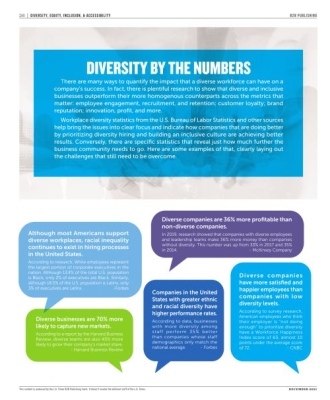
Although most Americans support diverse workplaces, racial inequality continues to exist in hiring processes in the United States.
According to research, White employees represent the largest portion of corporate executives in the nation. Although 13.4% of the total U.S. population is Black, only 2% of executives are Black. Similarly, although 18.5% of the U.S. population is Latinx, only 3% of executives are Latinx. -Forbes
Diverse businesses are 70% more likely to capture new markets.
According to a report by the Harvard Business Review, diverse teams are also 45% more likely to grow their company’s market share. -Harvard Business Review
Companies in the United States with greater ethnic and racial diversity have higher performance rates.
According to data, businesses with more diversity among staff perform 35% better than companies whose staff demographics only match the national average. -Forbes
Diverse companies are 36% more profitable than non-diverse companies.
In 2019, research showed that companies with diverse employees and leadership teams make 36% more money than companies without diversity. This number was up from 33% in 2017 and 35% in 2014. -McKinsey Company
Diverse companies have more satisfied and happier employees than companies with low diversity levels.
According to survey research, American employees who think their employer is “not doing enough” to prioritize diversity have a Workforce Happiness Index score of 63, almost 10 points under the average score of 72. -CNBC
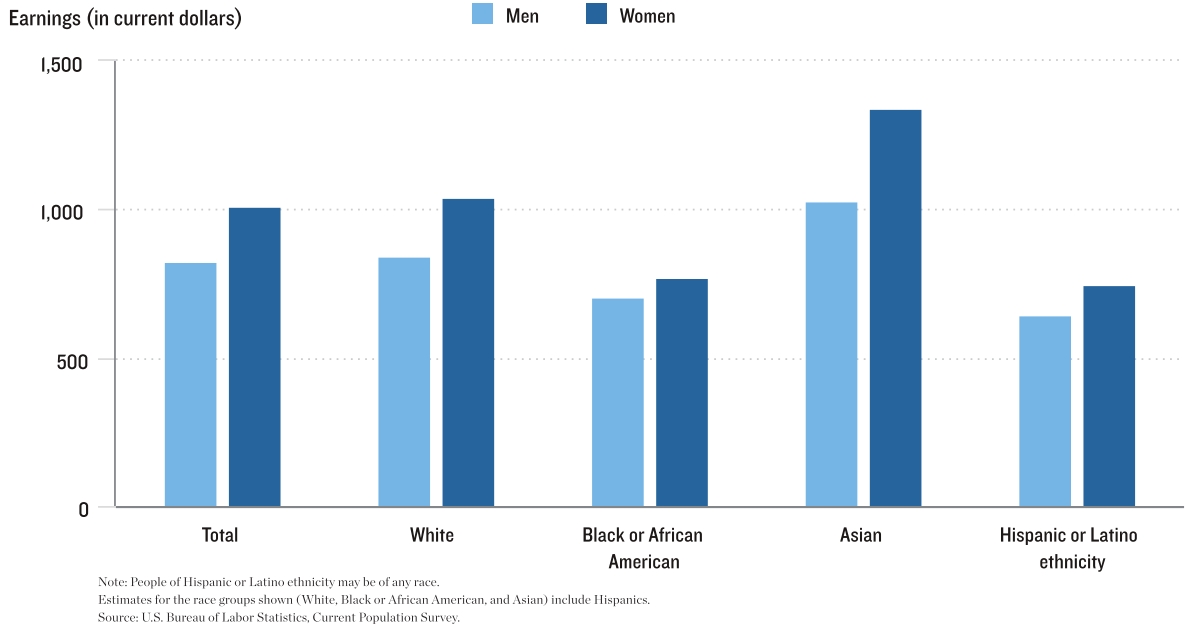
MEDIAN USUAL WEEKLY EARNINGS OF WOMEN AND MEN WHO ARE FULL-TIME WAGE AND SALARY WORKERS, BY RACE AND HISPANIC OR LATINO ETHNICITY, 2019 ANNUAL AVERAGES
REPRESENTATION BY CORPORATE ROLE, BY GENDER AND RACE, 2021, % OF EMPLOYEES