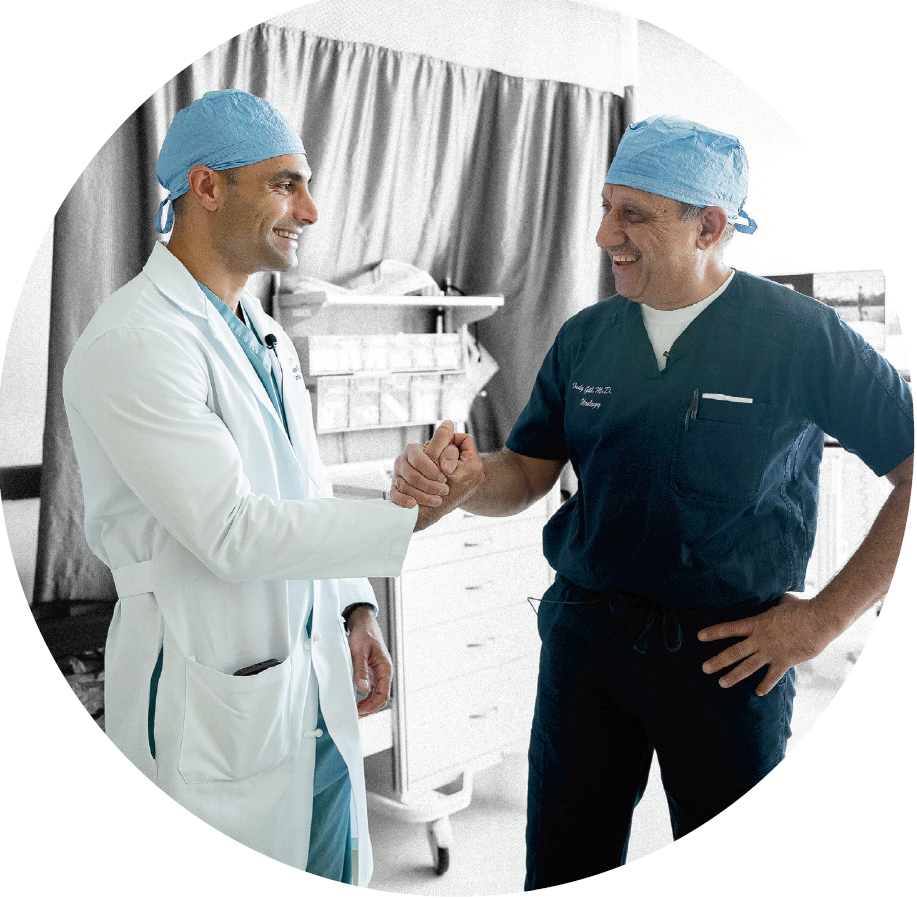
Nima Nassiri, MD (L) and Inderbir Gill, MD (R) collaborated on years of clinical research to prepare for the historic surgery. Historic surgery, the result of years of research at Keck Medicine of USC and UCLA Health, opens the door for improved treatment of nonfunctioning bladders
Surgeons from Keck Medicine of USC and UCLA Health have performed the world’s first-in-human bladder transplant. The surgery was successfully completed at Ronald Reagan UCLA Medical Center earlier this month in a joint effort by Inderbir Gill, MD, founding executive director of USC Urology, and Nima Nassiri, MD, urologic transplant surgeon and director of the UCLA Vascularized Composite Bladder Allograft Transplant Program.
A Groundbreaking Moment in Medical History
“This surgery is a historic moment in medicine and stands to impact how we manage carefully selected patients with highly symptomatic ‘terminal’ bladders that are no longer functioning,” said Gill, who is also chair and Distinguished Professor of Urology and Shirley and Donald Skinner chair in Urologic Cancer Surgery with the Keck School of Medicine of USC. “Transplantation is a lifesaving and life-enhancing treatment option for many conditions affecting major organs, and now the bladder can be added to the list.”
“This first attempt at bladder transplantation has been over four years in the making,” Nassiri said. “For the appropriately selected patient, it is exciting to be able to offer a new potential option.”
Nassiri, formerly a urology resident with the Keck School and now assistant professor of urology and kidney transplantation at UCLA, and Gill worked together for several years at the Keck School to develop the new surgical technique, design a clinical trial and secure the necessary regulatory approvals.
Numerous pre-clinical procedures were performed both at Keck Medical Center of USC and OneLegacy, Southern California’s organ procurement organization, to prepare for this first-in-human bladder transplant.
A Complicated Yet Successful Surgery
The patient had been dialysis-dependent for seven years. He lost the majority of his bladder during surgery to cancer resection over five years ago, leaving the remainder of his bladder too small and compromised to function appropriately. Both of his kidneys were subsequently removed due to renal cancer.
To address these deficits, Drs. Gill and Nassiri performed a combined kidney and bladder transplant, allowing the patient to immediately stop dialysis and produce urine for the first time in seven years. First the kidney, then the bladder, were transplanted. The new kidney was then connected to the new bladder. The entire procedure took approximately eight hours.
“The kidney immediately made a large volume of urine, and the patient’s kidney function improved immediately,” Nassiri added. “There was no need for any dialysis after surgery, and the urine drained properly into the new bladder.”
“Despite the complexity of the case, everything went according to plan and the surgery was successful,” said Gill. “The patient is doing well, and we are satisfied with his clinical progress to date.”
The recovery of the kidney and bladder from the donor was performed at OneLegacy’s Transplant Recovery Center in Azusa. All parts of the procedure, including surgery and postsurgical monitoring during the transplantation, were aligned with the highest current clinical and research standards.
The Generous Hero Who Made it Possible
While the surgeons’ achievement is historic, OneLegacy stresses that it is equally important to honor Amanda Cordier: a mother, wife, daughter and organ donor. Without her – and her extraordinary gift of life – this moment would not have been possible.
Cordier was a registered organ, eye and tissue donor. Her sudden passing left a profound void for her loving family, including her seven-year-old son. Her husband, Ryan Cordier, shared, "She was such a kind and giving person, so it only makes sense that she would continue to give all of herself to others, even in her passing. I am so proud of her decision and the legacy she has left behind. Because of that decision, so many lives will be impacted, and Oliver can see that his mama truly is a hero. In her short 37 years, she did so much more than many will be able to do in a whole lifetime."
Cordier saved five lives through the donation of her kidneys, liver, heart, lungs and bladder. Her corneas and tissue also helped heal dozens more. In her final act of love, she helped pave the way for future bladder transplant procedures.
“OneLegacy is proud to have provided the financial support for the clinical research that made this groundbreaking transplant possible,” said Prasad Garimella, CEO of OneLegacy. “OneLegacy provided all research organs involved in the clinical trials, but none of this would have been possible without the generosity of the organ donors and families who said ‘yes’ to organ donation.”

Organ donor Amanda Cordier.
How a Bladder Transplant Can Benefit Patients
Millions of people around the globe experience some degree of bladder disease and dysfunction. Some develop terminal bladders that are either non-functioning and/or cause constant pain, repeated infections and other complications. Current treatment for severe terminal cases of bladder dysfunction or a bladder that has been removed due to various conditions includes replacement or augmentation of the urinary reservoir. These surgeries use a portion of a patient’s intestine to create a new bladder or a pathway for the urine to exit the body.
“While these surgeries can be effective, they come with many short- and long-term risks that compromise a patient’s health such as recurrent infections, compromised kidney function and digestive issues,” said Gill.
“A bladder transplant, on the other hand, delivers a more ‘normal’ urinary reservoir and may circumvent some of the challenges associated with using the intestine,” said Nassiri.
The biggest risks of organ transplant are the body’s potential rejection of the organ and side effects caused by the mandatory immunosuppressive drugs given to prevent organ rejection.
“Because of the need for long-term immunosuppression, the best current candidates are those with a pre-existing organ transplant or those who need a combined kidney and bladder transplant,” said Nassiri.
As a first-in-human attempt, there are naturally many unknowns associated with the procedure, such as how well the transplanted bladder will function immediately and over time, and how much immunosuppression will ultimately be needed.
“Despite the unknowns, our goal is to understand if bladder transplantation can help patients with severely compromised bladders lead healthier lives,” said Gill.

Collaborative Research and Development Leading to the Transplant
Bladder transplants have not been done previously, in part because of the complicated vascular structure of the pelvic area and the technical complexity of the procedure. As part of the research and development stage, Drs. Gill and Nassiri successfully completed numerous practice transplantation surgeries at Keck Medical Center of USC, including the first-ever robotic bladder retrievals and successful robotic transplantations in five recently deceased donors with cardiac function maintained on ventilator support.
Several non-robotic trial runs of bladder recovery were performed at OneLegacy by Gill and Nassiri, allowing them to perfect the technique while working alongside multidisciplinary surgical teams.
The bladder transplant was done as part of a UCLA clinical trial. Gill and Nassiri hope to perform more bladder transplants together in the near future.
Under Gill’s leadership, USC Urology has rapidly established itself as a pioneer and world leader in the most advanced robotic urologic oncologic surgeries for kidney, bladder, prostate, testicular and penile cancers, and has achieved important milestones leveraging machine learning and artificial intelligence to optimize patient outcomes.
-Paul Williams

To view or share this content online, use this QR code.


