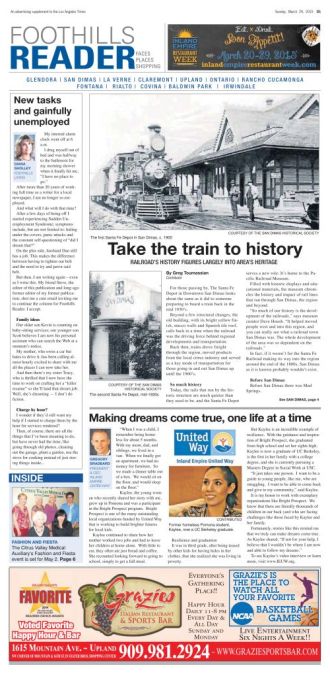
RAILROAD’S HISTORY FIGURES LARGELY INTO AREA’S HERITAGE
 For those passing by, The Santa Fe Depot in Downtown San Dimas looks about the same as it did to someone preparing to board a train back in the mid 1930’s.
Beyond a few structural changes, the old building, with its bright yellow finish, stucco walls and Spanish tile roof, calls back to a time when the railroad was the driving force behind regional developments and transportation.
Back then, trains drove freight through the region, moved products from the local citrus industry and served as a key mode of transportation for those going in and out San Dimas up until the 1960’s.
So much history Today, the rails that run by the historic structure are much quieter than they used to be, and the Santa Fe Depot serves a new role: It’s home to the Pacific Railroad Museum.
Filled with historic displays and educational materials, the museum chronicles the history and impact of rail lines that ran through San Dimas, the region and beyond.
“So much of our history is the development of the railroads,” says museum curator Dave Housh. “It helped moved people west and into this region, and you can really see what a railroad town San Dimas was. The whole development of the area was so dependent on the railroads.” In fact, if it weren’t for the Santa Fe Railroad making its way into the region around the end of the 1800s, San Dimas as it is known probably wouldn’t exist.
Before San Dimas Before San Dimas there was Mud Springs.
The name referred to nearby swamps in the area that local Gabrielino Indians depended upon for healing and spiritual needs.
By the 1880’s, the Santa Fe Railroad made its way into town leading a historic land boom in the region. Investors and developers in the area felt that Mud Springs wouldn’t sound appealing to potential visitors from across the country.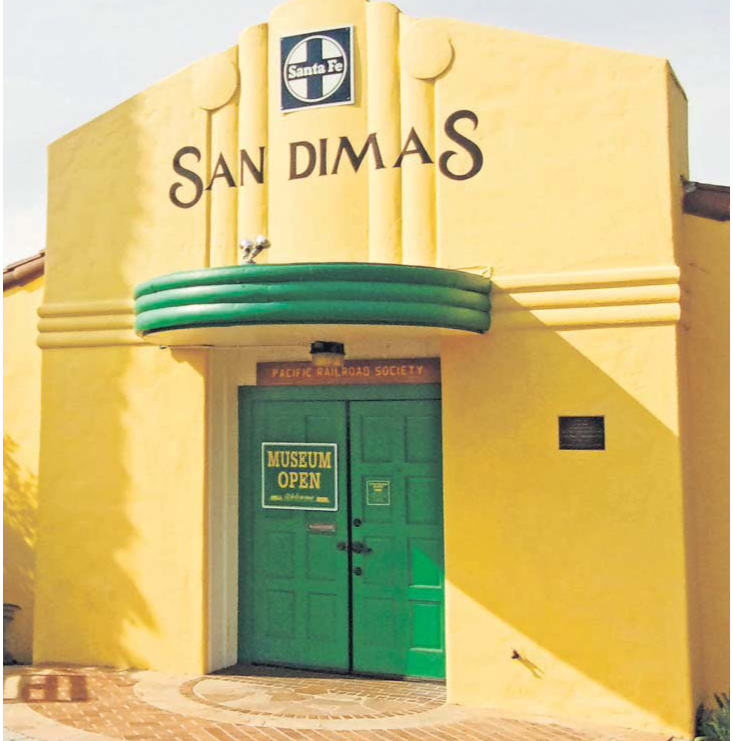
Inspired by the nearby Saint Dimas Canyon, the town of San Dimas was formed in 1887.
As the rail town developed, a depot was constructed to handle the new traffic rolling through the region. The ornate, Victorian styled structure opened in 1889, and would serve San Dimas for more than 40 years.
Settlers made their way into town during this time and the local citrus industry began to take off. The first packing house to cater to this growing industry opened in 1900, and several more were eventually constructed to meet the citrus demands.
There was a critical shortcoming in the design of these facilities, however, as the wooden floors inevitably became drenched with citrus oil.
One spark usually meant the end for these structures – in fact, most burned down.
From the Ashes On a windy day in 1933, a fire that started at a packing house just across the rails from the Santa Fe Depot man aged to spread onto the wooden station and destroyed most of the building.
By this time, four sets of railroad tracks ran through San Dimas, and handled freight, citrus and passenger traffic.
“It was such a critical station, with all this activity going on, that they quickly built a new depot,” Housh says. “They also wised up about the design.” The new depot opened in roughly a year, and it was designed by architect Herbert Gilman in a Spanish Colonial Revival style. With tile roofing and stucco walls, the new station’s art-deco build was much more fire resistant.
Trains continued to bustle through region but new challenges began to emerge. Rail was no longer the centerpiece of transportation as it was in the first part of the century.
Between airlines, autobuses and personal vehicles, ridership began to decline.
When the home construction boom following the Second World War, Citrus shipments from San Dimas began to taper off before finally ceasing in 1953.
Things really slowed down after that, and on Jan. 1, 1968, the Santa Fe Depot closed its doors and was sold to the City.
A New Home The depot would eventually become home to the Chamber of Commerce. It wasn’t until 1995 when the Pacific Railroad Society took over the facility.
The non-profit organization is one of the oldest and largest group of rail enthusiasts, involved in railroad preservation, education and documentation.
The depot is now home to the PRS’s extensive railroad research library of books, documents, maps and photographs that range all the way back to early 1900s.
“I welcome people to come out here and get a tour” Housh says. “There’s so much history in this region, people are secret in San Dimas for far too long,” The Pacific Railroad Museum is located at 210 W. Bonita Ave. in San Di mas.
It is open Monday and Wednesday from 12 PM to 5 PM, Saturday from 10 AM to 4 PM.
Docent led tours are free, and group tours are available on Friday by appointment. The museum is also looking for volunteers to help with museum operations.
For more information about the museum call (909)-394-0616 or visit pacificrailroadsociety.org for news and how to become a member.