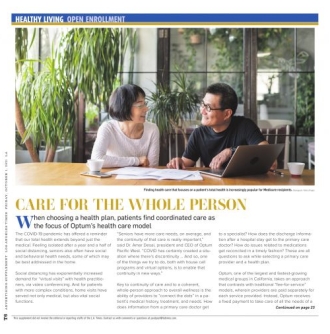
When choosing a health plan, patients find coordinated care as the focus of Optum’s health care model
The COVID-19 pandemic has
offered a reminder that our total health extends beyond just the
medical. Feeling isolated after a year and a half of social distancing,
seniors also often have social and behavioral health needs, some of
which may be best addressed in the home.
Social
distancing has exponentially increased demand for “virtual visits” with
health practitioners, via video conferencing. And for patients with
more complex conditions, home visits have served not only medical, but
also vital social functions.
“Seniors have more care
needs, on average, and the continuity of that care is really important,”
said Dr. Amar Desai, president and CEO of Optum Pacific West. “COVID
has certainly created a situation where there’s discontinuity … And so,
one of the things we try to do, both with house call programs and
virtual options, is to enable that continuity in new ways.”
Key
to continuity of care and to a coherent, whole-person approach to
overall wellness is the ability of providers to “connect the dots” in a
patient’s medical history, treatment, and needs. How does information
from a primary care doctor get to a specialist? How does
the discharge information after a hospital stay get to the primary care
doctor? How do issues related to medications get reconciled in a timely
fashion? These are all questions to ask while selecting a primary care
provider and a health plan.
Optum,
one of the largest and fastest-growing medical groups in California,
takes an approach that contrasts with traditional “fee-for-service”
models, wherein providers are paid separately for each service provided.
Instead, Optum receives a fixed payment to take care of all the needs
of a patient. This is accomplished through health plans such as Medicare Advantage.
“What
that enables us to do is really think about the total care of a patient
and develop clinical models that are best suited to what a patient’s
needs are,” Desai explained.
Optum
is a leader in this “coordinated care” approach, which helps manage
patient care thoughtfully and proactively across the entire health care
spectrum. This coordinated care creates sustainable networks to enable
truly patient-centered care at every stage of a patient’s health
journey.
Seniors tend
to value a deep relationship with not only their primary care physician,
but also with a complete care team – which may include medical
assistants, social workers, and pharmacists – dedicated to their overall
wellbeing. Optum roots its service in these relationships, while also
recognizing that some patients, such as those with multiple chronic
medical issues,
will benefit from what they term “wraparound” services, targeted at
their specific issues. For example, for someone experiencing congestive
heart failure or COPD, Optum will devise an individual disease
management program focused on their unique clinical needs.
Operating
throughout Los Angeles, Orange, San Diego, Riverside and San Bernardino
counties, Optum offers a best-of-both-worlds integration of convenient
and community-oriented care backed by the capabilities and technology of
a large organization to inform the services at local sites. This
enables continuity and individuality of local care, as opposed to
impersonal “big box” healthcare, yet with the resources of a leading
national medical group (Optum is part of UnitedHealth Group, the largest
single health carrier in the U.S.).
“[Patients]
get compassionate, convenient, and specialized care and that sense of a
team taking care of them that’s part of their local community, but also
all the benefits of the best technology and the most robust
capabilities to coordinate their care across the region,” said Desai.
Choosing
a health insurance plan during open enrollment should begin with
communication with a primary care provider familiar with your overall
health issues. It’s crucial to align health care needs with health plan
coverage; to make an informed decision based on your individual medical
situation and the benefit options available in your market.
“After
having the right kind of discussion with your doctor about your health
care needs, it’s important to then really get connected to an expert,”
Desai concluded. “Oftentimes that’s a licensed health insurance agent,
to provide patients with a free consultation. We’re happy to connect
patients to those types of agents.” For more information on Optum, visit
optum.com/california.