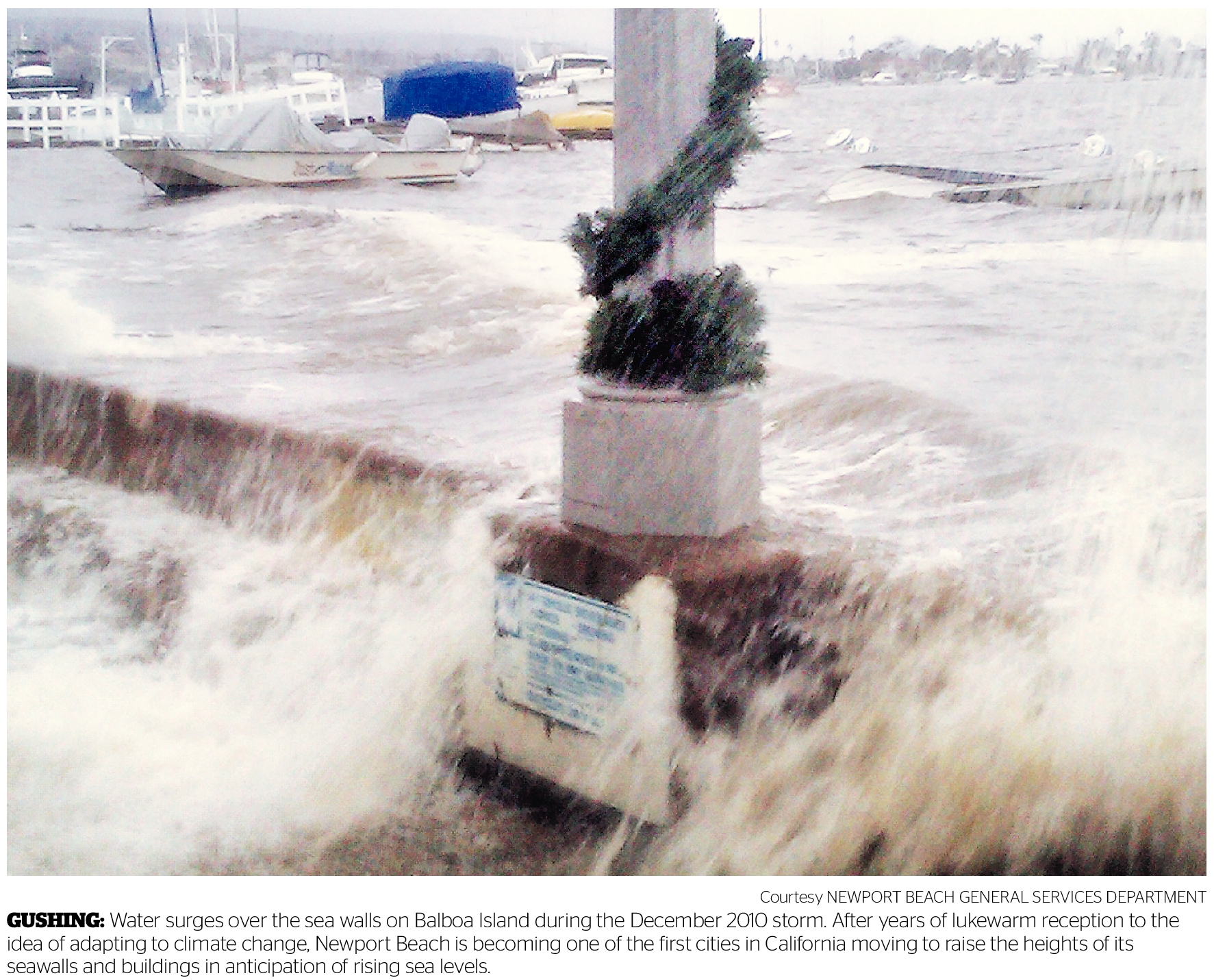
Newport Beach and other coastal communities take steps to avoid floods as high tides become higher.
FROM LATIMES.COM
Cities along California’s coastline that for years have dismissed reports of climate change or lagged in preparing for rising sea levels are now making plans to fortify their beaches, harbors and waterfronts.
Communities up and down the coast have begun drafting plans to build up wetlands as buffers against rising tides, to construct levees and seawalls to keep the waters at bay or to retreat from the shoreline by moving structures inland.
Among them is Newport Beach, a politically conservative city where a council member once professed to not believe in global warming. Now, the wealthy beach city is considered to be on the forefront of preparing for climate change.
Though some in Newport Beach remain skeptical that global warming caused by humans is elevating sea levels, city planners are looking at raising seawalls by a foot or more to hold back the ocean.
New homes along the city’s harbor are being built on foundations several feet higher than their predecessors as a precaution against flooding.
“I feel a real sense of urgency to begin planning for this right now,” Mayor Mike Henn said. “To me it’s irrelevant what the causes of global warming are. What we are dealing with is the reality that sea levels are rising.”
Sea levels have risen about 8 inches in the last century, and scientists expect them to rise several feet by the end of this century as climate change warms the ocean.
The focus on adaptation is a marked shift for cities such as Newport Beach that just a few years ago had made few preparations for the effects of climate change or were focusing on reducing their carbon footprints.
Even as the California Legislature passed a landmark law in 2006 to reduce greenhouse gas emissions, few coastal cities had any plans to confront rising waters on their own shores.
“The state of preparedness was close to zero in terms of looking forward to climate change and what it’s going to bring,” said Susanne Moser, a social science researcher at the Woods Institute for the Environment at Stanford University, who has surveyed coastal cities and counties about planning for rising sea levels. “Since then there’s been an explosion of interest on the local level.”
In Newport Beach, the attitude change came in response to concerns about the future of its harbor, an expansive waterfront dotted with islands and sheltered from the open ocean by the densely populated Balboa Peninsula.
Tens of thousands of people live in the area, much of it just a few feet above sea level.
After a sea level rise of just over a foot, a 2008 city-commissioned study said, an extreme high tide would result in widespread flooding on Balboa Peninsula and “near-complete flooding of Balboa Island.”
With that in mind, Newport Beach officials are focusing on low-lying Balboa Island, a tightly packed neighborhood of homes and beach cottages where locals zoom through the streets on golf carts and navigate the harbor in electric boats.
A narrow sand spit that was dredged into an island a century ago, Balboa Island now houses nearly 2,000 homes, which are considered to be at the greatest risk of flooding in the city.
To protect against that possibility, new homes are already being built on foundations about 3 feet higher than the historic beach cottages they replace. And the city is conducting a study of the island’s seawalls, built in the 1920s and ’30s, to determine how high
See SEA, page C70


