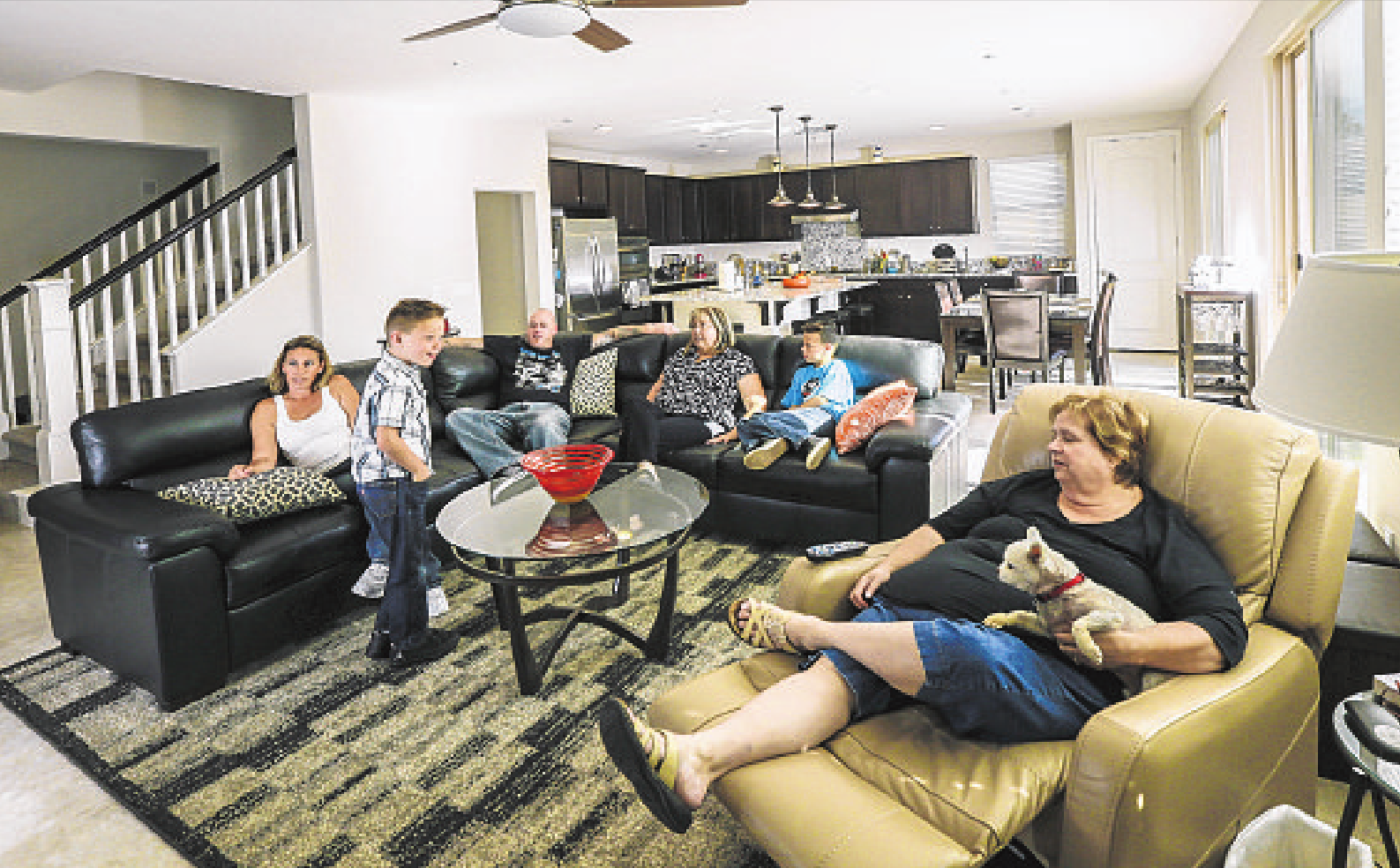
Home’s layout affords togetherness when it’s called for but enough privacy for everyone.
Marie Clausman knows what it’s like to live in a full house. In November, she moved into a newly built Inland Empire home with her daughter, her daughter’s partner and the couple’s two sons. Oh, and Clausman’s sister moved in too.
Their two-story home is a GenSmart model, designed for families that — through either choice, culture or circumstance — are fitting multiple generations under the same roof. The reasons are diverse: the prohibitive cost of senior care, an unemployed family member, young adults hoping to save money by living at home a while longer.
In Clausman’s case, she was looking to share living costs after her packaging business hit a rough patch; around the same time, her sister’s husband passed away. The pair became roommates in Highland, and a few years later, Clausman’s daughter decided to bring her household into the fold.
So six people across three generations moved into a 3,700- square-foot house in the new Woodmont master-planned community in Beaumont.
Clausman, 64, occupies a suite on the lower floor with a separate living room, kitchenette and private entrance. Sister Linda has her own master bedroom and bathroom. Clausman’s daughter’s family of four lives in the upstairs unit, which has three bedrooms, two bathrooms and a bonus room.
The whole family shares the main kitchen, the living room and the dining room.
“It’s a perfect situation for us,” Clausman said. “It’s like having three houses in one. We all eat together, but we also have our privacy when we want it.”
Matt Sauls, vice president of marketing and product development at Pardee Homes, which created the GenSmart model, said the homes — which are available in some of the company’s housing developments — came about in response to buyer demand.
“Demographics are changing, and multiple generations of family members are becoming more comfortable living together,” he said.
As a result, architects and developers are thinking ahead, incorporating a “what if” approach.
“There
have to be multiple solutions to make it work,” said Ken Niemerski,
senior principal at Newport Beach architecture firm Bassenian Lagoni,
which designed the Woodmont development. “Our goal is to create an area
within a home where someone can eat, live, sleep, have a bathroom and
have a space that’s set aside for them but where there’s connectivity
inside the house.”
Sherman
Jones, studio director at Robert Hidey Architects in Irvine, said his
company has fielded numerous requests to create multigenerational living
spaces. Jones worked on the Asher at Playa Vista development, built by
KB Homes, which allows for diverse living arrangements by offering
living and bedroom suites with their own entrances.
The
architecture firm was also behind the spacious Lambert Ranch homes in
Irvine, which are designed for older generations living alongside
younger and which, in a nod to cultural considerations, even feature a
second kitchen just for wok cooking.
“I’m
seeing siblings with their families conjoining households, or grown
children with kids who have boomeranged back home to live with an older
generation,” said Jones. “No matter the circumstances, there needs to be
an attitude of privacy.”
Some people, instead of moving to a new multigenerational home, are renovating on their own to fit additional family members.
Last
year Valery Rangel bought an Azusa house that, with some work, would
comfortably accommodate her, her 14-year-old son and her parents.
Her
father, who works in construction, is expanding the house from 1,100 to
1,700 square feet, including adding a new bathroom and enlarging the
kitchen. Rangel said that, as a single mother, finding a way to live
with her parents gave her security.
“It
makes sense for us to do it this way,” the fashion blogger said. “We’re
consolidating. And my father is customizing the rooms to be how we want
them. Later, when we have the budget, if I want to make a bedroom out
of the garage, I can do that.”
Heather
Witt Leikin, a broker with Douglas Elliman, says she is routinely asked
to find homes for clients that can be used by multiple generations, now
or in the future.
“Instead
of people thinking about having a maid’s room, they want a downstairs
master suite,” she said. “Or college graduates and millennials coming
home who don’t want their rooms right next to their parents’ rooms.”
hotproperty@latimes.com


