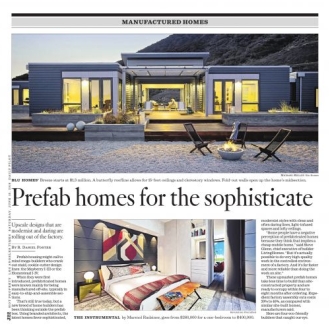
Upscale designs that are modernist and daring are rolling out of the factory.
Prefab housing might call to mind mega-builders who crank out staid, cookie-cutter design lines: the Mayberry I-III or the Homestead I-IV.
When they were first introduced, prefabricated homes were known mainly for being manufactured off-site, typically in easy-to-ship-and-assemble sections.
That’s still true today, but a new breed of home builders has been thinking outside the prefab box. Using branded architects, the latest homes favor sophisticated, modernist styles with clean and often daring lines, light-infused spaces and lofty ceilings.
“Some
people have a negative perception of prefabricated homes because they
think that implies a cheap mobile home,” said Steve Glenn, chief
executive of builder LivingHomes. “But it’s actually possible to do very
high-quality work in the controlled environment of a factory. And it’s
far faster and more reliable than doing the work on site.”
These
upmarket prefab homes take less time to build than siteconstructed
property and are ready to occupy within four to eight months after
ordering. Expedient factory assembly cuts costs 20% to 40%, as compared
with similar site-built homes, manufacturers said.
Here are four eco-friendly builders that caught our eye.
Prices do not include site prep and other costs.
Blu Homes Blu Homes’ Vallejo factory turns out 16 architect-designed models ranging from $235,000 to $1.855 million.
The
one-story Breeze, starting at $1.3 million, is the iconic trendsetter
in the line. A butterfly roofline allows for 15-foot ceilings and rows
of clerestory windows. NanaWalls fold out front and back, opening up the
home’s entire midsection.
Also
noteworthy: the Zen-like Lotus design, which starts at $725,000 for two
bedrooms, and the spacious three-bedroom Modern Farmhouse, $975,000.
“We
cut out the middleman and do it all — both design and engineering,” Blu
Homes co-founder Bill Haney said of the firm’s 250,000-square-foot
factory.
Blu Homes’ app enables buyers to set up an entire home’s look — swapping out decks, appliances, bedrooms and more.
Proto Homes Proto
Homes’ downtown Los Angeles factory creates modernist designs priced
from $175 to $275 per square foot. Halton Pardee and developer Core
Vision are partners.
Jonard
Soriano and his wife, Angela Cheung, chose Proto Homes’ midline home
package, customizing it with upgraded kitchen appliances.
In
2013, they moved into their 2,200-square-foot Burbank Proto Home after
eight months of construction. Cantilevers frame the midcentury look with
ceilings that top out at 20 feet. Base price: $490,000.
The
couple favored the firm’s use of prefabricated sections and walls,
rather than entire modules, asystem the company calls Flex Zone. The
second floor, currently configured as two rooms, can be swapped out for
four.
“I can even move the existing walls myself,” Soriano said.
Proto
Homes consolidates all electrical, plumbing, and mechanical systems
into a single space it calls the “core,” allowing for easy access.
“That attracted us,” Soriano said. “I owned a traditionally built home before, and maintenance was a headache.”
LivingHomes Santa Monica-based LivingHomes features two
branded architects, Ray Kappe and Kieran- Timberlake, as well as
lower-cost designs in its CK and C6 series. Price range: $139 to $230
per square foot.
Kappe’s
designs include a home set in multilevel planes, clad in cement and
cedar, and topped by a “living roof” garden ($665,000).
Home module construction is outsourced to nine U.S. factories. All homes are green-certified as LEED Silver or above.
Sterling
Scott and Michael Abels recently bought a postmodern designed home clad
in cement board, from the firm’s CK series, for $300,000.
The 1,700-square-foot, threebedroom home, built in four sections, will be craned onto a Silver Lake slope in July.
Scott
said navigating the city permit process was vexing during previous
build attempts, but was straightforward with LivingHomes.
“LivingHomes
knew all the requirements, and the city had few questions,” he said,
adding that buying a factory-built home “takes out all the unknowns,
especially the cost.”
Revolution Precrafted Properties
Revolution
sources its designs from 30 architects, many with stellar credentials:
Zahra Hasid, I.M. Pei, Rem Koolhaas, Tadao Ando and Richard Meier.
Revolution, which has its headquarters in Manila, outsources
manufacturing to various factories throughout the world. Base price:
$250,000 to $500,000.
The
Instrumental, by Marmol Radziner, is warmly modernist: A cantilevered
glassed rectangle includes deck extensions that neatly tie the building
to surroundings.
The 517-square-foot one-bedroom: $260,000. The 1,033-squarefoot two-bedroom: $400,000.
Revolution founder Robbie Antonio calls his limited-edition creations “architectural collectibles.”
They
also include Casa A, a 485-square-foot cylinder-shaped pod with a
retractable roof, designed by SelgasCano, and the 1,022-square-foot
spaceship-styled Nest Pod by Fernando Romero, both not yet priced.
hotproperty@latimes.com