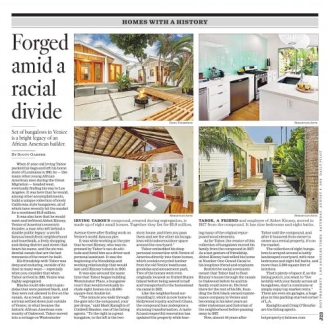
Set of bungalows in Venice is a bright legacy of an African American builder.
When 17-year-old Irving Tabor packed his bags and left his home state of Louisiana in 1910, he — like many other young African American men during the Great Migration — headed west, eventually finding his way to Los Angeles. It was here that he would, among other accomplishments, build a unique collection of lovely California-style bungalows, all of which have recently hit the market for a combined $5.8 million.
It was also here that he would meet and befriend Abbot Kinney, Venice of America’s eccentric founder, a man who left behind a sizable public legacy: a worldfamous beachfront neighborhood and boardwalk, a lively shopping and dining district and street that bears his name, and the six residential canals that are the last remnants of the resort he built.
His friendship with Tabor was deep and enduring, outside of its time in many ways — especially when you consider that when Tabor arrived in 1910, Venice was highly segregated.
Blacks could ride only in gondolas that were painted black, and they were not allowed to live on the canals. As a result, many new arrivals settled down just outside of Venice, in what became the historic African American community of Oakwood. Tabor moved into a cottage on Westminster Avenue there after finding work on Venice’s world-famous pier.
It
was while working at the pier that he met Kinney, who was impressed by
Tabor’s can-do attitude and hired him as a driver and personal
assistant. It was the beginning of a friendship and working relationship
that would last until Kinney’s death in 1920.
It
was also around the same time that Tabor began building Westminster
Place, a bungalow court that would eventually include eight homes on a
10,000- square-foot double lot.
“The
minute you walk through the gate into the compound, your jaw drops,”
said Mark Kanights of Coldwell Banker, one of the listing agents. “To
the right is a great bungalow, to the left is the two story house, and
then you pass them and see the other six bungalows with indoor/outdoor
space around the courtyard.”
Tabor
embedded his deep personal connection with Venice of America directly
into these homes, which contain recycled lumber from the old Venice
boathouse, gondolas and amusement park. Two of the homes were even
originally located on United States Island before being sawed in half
and transported to the homestead via canal in 1922.
Like
the neighborhood surrounding it, which is now home to Hollywood royalty
and tech titans, the compound has undergone a stunning transformation. A
tasteful and respectful renovation has updated the property while
leaving many of the original repurposed wood elements.
As
for Tabor, the creator of this collection of bungalows moved his family
from the compound in 1927: As a last gesture of friendship, Abbot
Kinney had willed his home at Number One Grand Canal to his longtime
friend and employee.
Restrictive
racial covenants meant that Tabor had to float Kinney’s house through
the canals to Oakwood before he and his family could move in. He lived
there for the rest of his life, founding the first black-owned
maintenance company in Venice and becoming in his later years an elder
statesman and historian of the neighborhood before passing away in 1987.
Now,
almost 44 years after Tabor sold the compound, and after it bounced
from owner to owner as a rental property, it’s on the market.
The
collection of eight bungalows is arrayed around a lushly landscaped
courtyard, with nine bedrooms and eight full baths, and more than 5,000
square feet of interiors.
That’s
plenty of space if, as the listing puts it, you want to “live lavishly
with your family across all bungalows, start a commune or simply enjoy
top market rents.” There are even six garages, a huge plus in this
parking-starved corner of L.A.
Kanights and Craig O’Rourke are the listing agents.
hotproperty@latimes.com