Technological progress and natural disasters punctuate the mission area’s history.
Mission San Fernando has stood watch over the Valley floor in one form or another for the last 220 years.
The building we’re familiar with today is on the site where generations of Angelenos have marked the milestones of life, from joyful baptisms to the solemn business of funeral Masses, and the confirmations, quinceañeras and weddings that fill the years between.
It provides a connection between today’s Los Angeles and its foundational era — a rare continuity in an ever-changing metropolis —but the well-worn path between the past and present is not unbroken. The acts of men and the periodic convulsions of the unsettled earth have seen the mission razed and rebuilt several times over.
As has happened to so many relics of L.A.’s past, the mission enjoyed a heyday that was followed by a long period of neglect.
The slow, patient reclamation of the adobe church by the elements was accelerated by the devastating 1812 Wrightwood quake, which claimed a number of missions across Southern California as its victims. By the 1880s, the place stood in ruins.
When the Pacific Electric Railway opened a line from Los Angeles to San Fernando, picnicking trips to the sun-bleached ruins of the mission, spurred on by the romanticization of the Spanish colonial era, became a popular way to while away a Sunday afternoon.
This steady stream of visitors spurred interest in restoring the old mission to something approaching its former glory, and in 1916 the painstaking process of bringing the church and its outbuildings back to life began.
Twenty-five years later, the church was rededicated. Thirty years after that, the Sylmar quake damaged it so severely that it had to be demolished, and a new
church in the style of the old was built in its place. In the years
between the mission’s latest rebirths, the area around it had changed
dramatically. Once one of the Valley’s few remaining pockets of
agricultural land, the neighborhood that would be dubbed Mission Hills
saw explosive suburbanization in the post-war years.
It
eventually became, in effect, the crossroads of the Valley, encircled
by three freeways that funnel traffic to destinations near and far. Just
a few blocks away, on the quiet grounds of the old mission, girls of
another generation pose proudly in pastel dresses as they celebrate
their passage into womanhood.
Neighborhood highlights The history of the Valley: From
the grounds of the old mission itself to the Andres Pico adobe, there
are few places outside the plaza that give a better sense of early
European life in L.A.
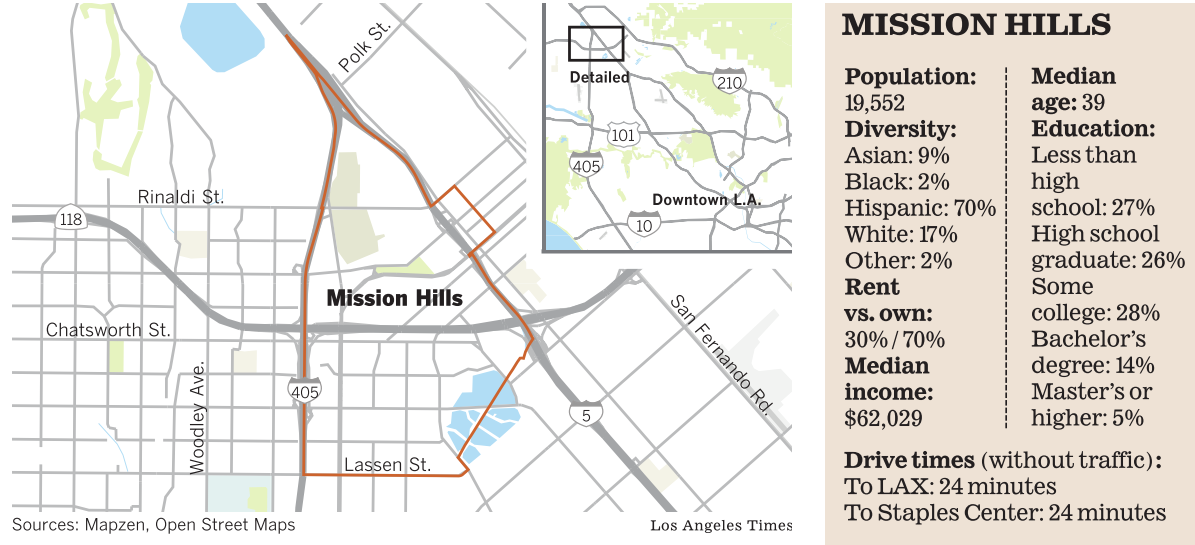
At the crossroads: Whether you’re commuting to Santa Clarita, downtown, the Westside or Pasadena, Mission Hills has a freeway with your name on it.
Affordable Valley living: You
won’t break the bank buying in Mission Hills, where median home prices
are in the mid-$400,000s, with the low end of prices dipping into the
high $300,000s.

Neighborhood challenge Particular about particulates: The
convenience of all that freeway access comes with a big asterisk poor
air quality caused by the hundreds of thousands of cars that pass by
every day.
Expert insight Adrian
Lopez, a real estate agent active across the Valley, said that even
though Mission Hills has been growing, its identity still gets lumped in
with larger neighbors such as Granada Hills and San Fernando.
“Your
commute may be longer, but you can get a three-bedroom, two-bathroom
home much cheaper here than in other areas,” Lopez said.
He
added that home prices have drawn many families the last few years, and
developers are having a hard time keeping up with demand.
“Looking ahead, overpopulation may become more of a problem,” Lopez said.
Market snapshot In
the 91345 ZIP Code, based on three sales, the median sales price for
single-family homes in February was $475,000, with no change year over
year, according to Core- Logic.
Report card The
one public school in Mission Hills, San Jose Street Elementary, scored
831 on the 2013 Academic Performance Index. Highlights in the area
include Danube Avenue Elementary, which scored 848, and Haskell
Elementary, which scored 836. The area’s two high schools, Arleta High
and San Fernando Senior High, scored 718 and 671, respectively.
hotproperty@latimes.com Times staff writer Jack Flemming contributed to this report.