L.A. continues to add to its list of historic districts. These are the latest.
Last year, the city of Los Angeles approved a bumper crop of historic districts — five neighborhoods packed with distinctive architecture. Called historic preservation overlay zones, the districts now number 35 and harbor 21,000 properties safeguarded from undue alteration.
Only New York City surpasses L.A. in the number of structures covered by historical designation.
The recent approvals represent “the city’s effort to address overdevelopment and mansionization,” said Adrian Scott Fine, director of advocacy at the L.A. Conservancy.
The city adopted its historic zone ordinance in 1979 as a way to protect groups of historic homes that lend architectural relevance to their neighborhoods; Angelino Heights was the first. The districts put the brakes on untoward exterior changes that disfigure singular architecture. Proposed alterations are reviewed by the city and historic zone boards.
The city distinguishes between “contributing” structures that retain historic features — homes built during years of architectural significance — and “contributing altered” buildings that include additions or changes deemed reversible.

Carthay Square 1924-1949 Carthay Square joins bordering Carthay Circle and South Carthay as the newest historic district in west-central Los Angeles. Of the neighborhood’s 347 single- and multi-family homes, an impressive 93% are deemed as contributing to the area’s historic fabric.
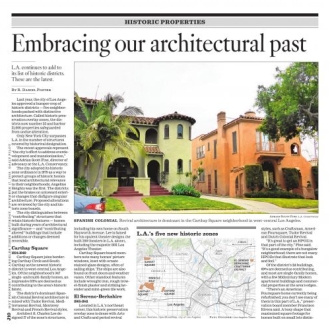
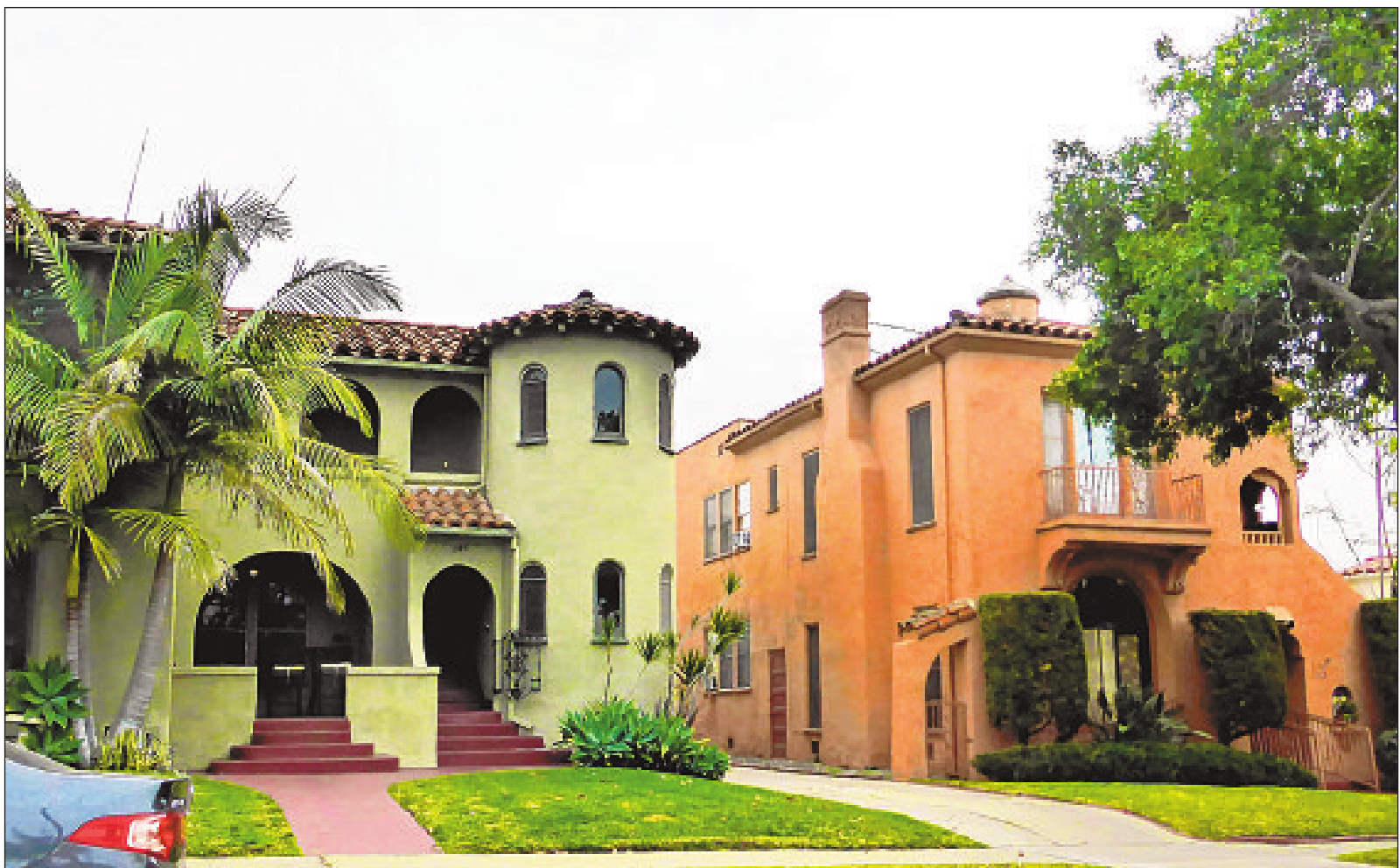
The district’s dominant Spanish Colonial Revival architecture is mixed with Tudor Revival, Mediterranean Revival, Monterey Revival and French Revival styles.
Architect S. Charles Lee designed 17 of the zone’s structures, including his own home on
South Hayworth Avenue. Lee is famed for his opulent theater designs (he
built 250 theaters in L.A. alone), including the majestic 1931 Los
Angeles Theater.
Carthay
Square board members note many homes’ picture windows, inset with
ornate stained-glass designs, often of sailing ships. The ships are also
found on front doors and weather vanes. Other standout features include
wrought iron, rough trowel-finish plaster and striking lavender and
mint-green tile work.
El Sereno-Berkshire 1905-1941 Located
in L.A.’s northeast corner, this historic preservation overlay zone is
dense with Arts and Crafts and period revival styles, such as Craftsman,
American Foursquare, Tudor Revival and Dutch Colonial Revival.
“It’s
great to get an HPOZ in that part of the city,” Fine said. “It’s a good
example of a bungalow neighborhood; there are not many HPOZs that
illustrate that look and feel.”
Of
the district’s 114 buildings, 69% are deemed as contributing, and most
are single-family homes, with a few Midcentury Modern apartment
buildings and commercial properties at the area’s edges.
“There’s
an American Foursquare home currently being refurbished; you don’t see
many of them in this part of L.A.,” preservation board member Francisco
Rivera said. A boxy shape that maximized square footage for homes built
on small lots distinguished the early 20th century style.

Oxford Square 1907-1941 Arts
and Crafts and period revival modes prevail in the neighborhood’s 191
single-family homes, which line both sides of Windsor Boulevard and
Victoria Avenue, about five miles west of downtown.
More than 60% of the homes were built between 1920 and 1930, and 74% of residences are deemed as contributing.
“We
have a 1910 Craftsman in our neighborhood that has Polynesian
influences –– it looks like a South Seas house,” board member Kory Odell
said.
The corbels are
carved to resemble Polynesian boats, he said, and the roofline’s fascia
boards swoop down “like an early sailing ship.”
Several
homes have Swiss Chalet variations on the Craftsman style, and others
have original Gothic wallpaper and handhammered copper fireplace
mantels, Odell said.
Sunset Square 1908-1941
This
western Hollywood historic zone was built as a streetcar suburb along
the Pacific Electric Railway line. Most of the 349 single- and
multi-family homes were built between 1910 and the 1920s, and 62% are
deemed as contributors or altered contributors.
Architectural styles are diverse, with Craftsman, Spanish Colonial Revival and American Colonial Revival dominating.
The
district has two locally designated Historic-Cultural Monuments: a 1915
Japanese Craftsman and a 1923 Mayaninspired home designed by Lloyd
Wright that marks the first use of his textile-block concrete
construction method.

“Our
neighborhood represents the residential fabric of early Hollywood,”
said Cheryl Holland, president of the Sunset Square Neighborhood
Organization, “from smaller bungalows to the east that housed people
working in the studios, to the west where Norma Shearer and other actors
lived.”
Miracle Mile 1921-1953 The
largest of the new zones, Miracle Mile has 1,347 properties located in
the Mid-Wilshire area, and 80% are deemed contributors or altered
contributors to the district. Period revival architecture reigns within
single- and multi-family homes: Spanish Colonial Revival, Tudor Revival,
Mediterranean Revival, French Revival and American Colonial Revival.
Notable
architects include S. Charles Lee, Edith Northman, R.M. Schindler,
Louis Selden, Paul R. Williams and the firm Morgan, Walls &
Clements.
“We have
some wonderful Chateauesque apartment buildings with turrets, courtyards
and fountains; 60% of our residents are renters,” said Ken Hixon, vice
president of the Miracle Mile Residential Assn.
hotproperty@latimes.com