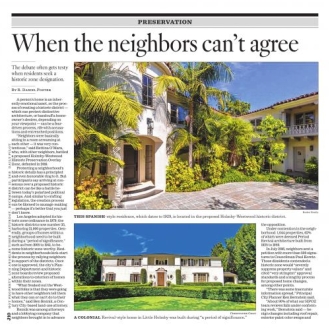
The debate often gets testy when residents seek a historic zone designation.
Aperson’s home is an inherently emotional asset, so the process of creating a historic district — which can protect distinctive architecture, or handcuff a homeowner’s desires, depending on your viewpoint — can be a feardriven process, rife with accusations and entrenched positions.
“Neighbors were basically sitting in a room screaming at each other — it was very contentious,” said Bettina O’Mara, who, with other neighbors, battled aproposed Holmby-Westwood Historic Preservation Overlay Zone, defeated in 2016.
Protecting a neighborhood’s historic details has a principled and even honorable ring to it. But participants say arriving at consensus over a proposed historic district can be like a battle between today’s polarized political camps. And similar to crafting legislation, the creation process can be likened to sausage-making –– perhaps it’s better that you just don’t know.
Los Angeles adopted its historic zone ordinance in 1979; the historic districts now number 35, harboring 21,000 properties. Generally, groups of homes within a neighborhood need to be built during a “period of significance,” such as from 1905 to 1941, to become historic zone-worthy. Residents in neighborhoods kick-start the process by rallying neighbors in support of the districts. Once one is approved, the city’s Planning Department and historic zone boards review proposed alterations to exteriors of homes within their zones.
“What freaked out the Westwood folks is that they were going to have other neighbors tell them what they can or can’t do to their homes,” said Ben Reznik, a Century City-based land-use attorney.
Reznik was among attorneys and a lobbying company that neighbors brought in to advance the opposition.

Under
contention in the neighborhood: 1,044 properties, 62% of which were
deemed Period Revival architecture built from 1925 to 1959.
In July 2016, neighbors sent a petition with more than 500 signatures to Councilman Paul Koretz.
Those
dissidents contended a historic zone would “severely suppress property
values” and cited “very stringent” approval standards and a lengthy
process for proposed home changes, among other points.
“There was some inaccurate information spread,” Principal City Planner Ken Bernstein said.
“About
90% of what our HPOZ team reviews falls under conforming work,”
Bernstein said — benign changes including roof repair, exterior paint
color swaps and small rear additions, which can be approved in three to 21 days.
“The
fears about HPOZs are way out of proportion to the reality,” said
Adrian Scott Fine, director of advocacy at the L.A. Conservancy. He
called the boards “judicious,” with proposed home changes approved in
the high 90% range.
Falsehoods
were rebutted in a mailer sent by preservation zone supporters. The
corrections: Modern-style homes can be built, homes on corner lots can
be expanded and second-story additions are allowed.

In
fact, significant additions are common within historic zones, although
they require a higherlevel review of up to 75 days, and a fee that tops
out at $2,600. If denied, an application can be appealed, which can take
up to 75 additional days.
Opposing
camps met, but talks were curt and ineffective, said Susan Reuben, vice
president of the Holmby Westwood Property Owners Assn.
“There wasn’t any attempt to work it out, to talk it out,” said Reuben, a historic zone backer.
Negotiations
between the city and neighbors did loosen some points in the district’s
preservation plan, a guideline for home changes. That included adding
greater flexibility to side and rear elevation changes on homes.
“We took care to include voices who were skeptical or even in opposition,” Bernstein said.
Fears
about property values are more common for historic zones proposed in
wealthier areas, which can be correspondingly more contentious.
Affluent Hancock Park, for example, also endured a caustic debate before the district was approved in 2008.
Fine
and others cited numerous studies showing that property values are
either maintained or, more often, “increase at a higher rate because the
neighborhood’s character is kept intact,” he said.
Despite
the studies, Reznik said, “I don’t think it’s proven,” adding that he
believes “the marketplace can’t play out,” in terms of rebuilding and
home expansion within such historic zones.
The
L.A. Conservancy is conducting a study that includes historic zone
property values, with findings scheduled for release in early 2019.
The definition of a Historic Preservation Overlay Zone
can remain vague to many residents, even with neighborhood outreach and
meetings, until the proposal is presented by the city in a public
workshop.

By that
time, a consulting firm has completed a survey of historical resources,
and the city Planning Department, a draft preservation plan.
In
the end, a City Council vote determines a proposed zone’s fate; council
members are kingpins to the process as they follow their constituents’
lead. Koretz pulled his support in September 2016. His office did not
respond to requests for comment.
Holmby-Westwood
groups “did alot of outreach” to educate residents about Historic
Preservation Overlay Zones, Fine said. “It doesn’t mean they couldn’t
have done more.
“From
my perspective: Do as many meetings as you think you should do and then
do many more,” he said. “A lot of misconceptions take root and take on a
life of their own. It’s hard to take people back to reality.”
hotproperty@latimes.com