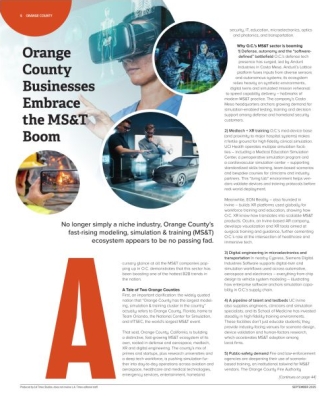
No longer simply a niche industry, Orange County’s fast-rising modeling, simulation & training (MS&T) ecosystem appears to be no passing fad.
A cursory glance at all the MS&T companies popping up in O.C. demonstrates that this sector has been boosting one of the hottest B2B trends in the nation.
A Tale of Two Orange Counties
First, an important clarification: the widely quoted notion that “Orange County has the largest modeling, simulation & training cluster in the country” actually refers to Orange County, Florida, home to Team Orlando, the National Center for Simulation, and I/ITSEC, the world’s largest MS&T event.
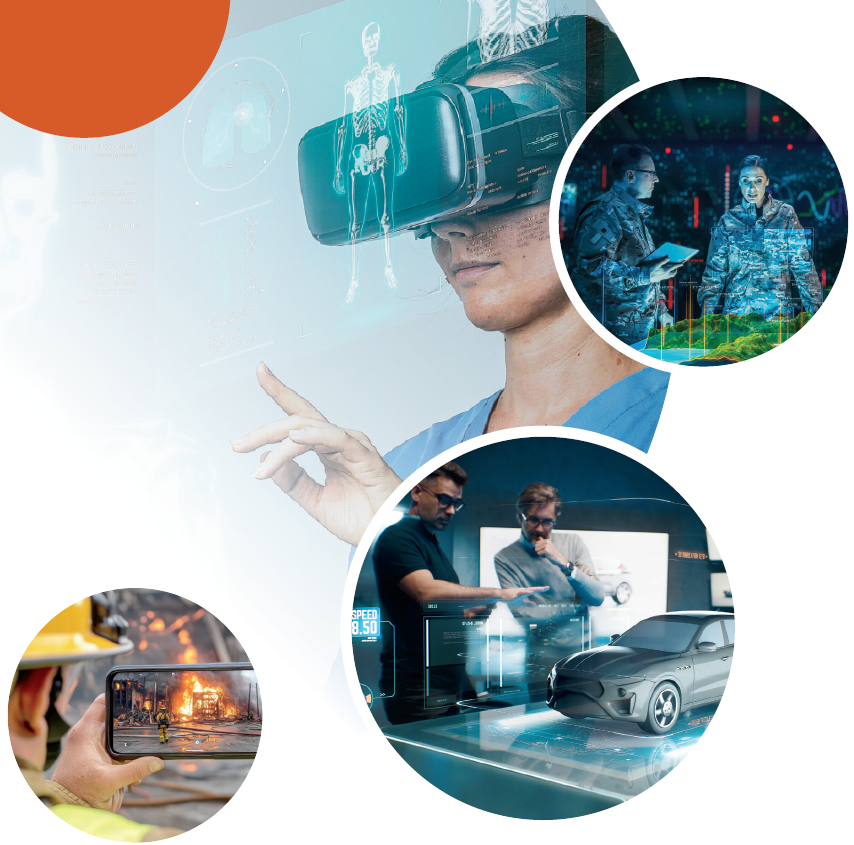
That said, Orange County, California, is building a distinctive, fast-growing MS&T ecosystem of its own, rooted in defense and aerospace, medtech, XR and digital engineering. The county’s mix of primes and startups, plus research universities and a deep tech workforce, is pushing simulation further into day-to-day operations across aviation and aerospace, healthcare and medical technologies, emergency services, entertainment, homeland security, IT, education, microelectronics, optics and photonics, and transportation.
Why O.C.’s MS&T sector is booming
1) Defense, autonomy and the “software-defined” battlefield O.C.’s defense tech presence has surged, led by Anduril Industries in Costa Mesa. Anduril’s Lattice platform fuses inputs from diverse sensors and autonomous systems; its ecosystem relies heavily on synthetic environments, digital twins and simulated mission rehearsal to speed capability delivery – hallmarks of modern MS&T practice. The company’s Costa Mesa headquarters anchors growing demand for simulation-enabled testing, training and decision support among defense and homeland security customers.
2) Medtech + XR training O.C.’s med-device base (and proximity to major hospital systems) makes it fertile ground for high-fidelity clinical simulation. UCI Health operates multiple simulation facilities – including a Medical Education Simulation Center, a perioperative simulation program and a cardiovascular simulation center – supporting standardized skills training, team-based scenarios and bespoke courses for clinicians and industry partners. This “living lab” environment helps vendors validate devices and training protocols before real-world deployment.
Meanwhile, EON Reality – also founded in Irvine – builds XR platforms used globally for workforce training and education, showing how O.C. XR know-how translates into scalable MS&T products. Ocutrx, an Irvine-based AR company, develops visualization and XR tools aimed at surgical training and guidance, further cementing O.C.’s role at the intersection of healthcare and immersive tech.
3) Digital engineering in microelectronics and transportation In nearby Cypress, Siemens Digital Industries Software supports digital-twin and simulation workflows used across automotive, aerospace and electronics – everything from chip design to vehicle system modeling – illustrating how enterprise software anchors simulation capability in O.C.’s supply chain.
4) A pipeline of talent and testbeds UC Irvine also supplies engineers, clinicians and simulation specialists, and its School of Medicine has invested steadily in high-fidelity training environments. These facilities don’t just educate students; they provide industry-facing venues for scenario design, device validation and human-factors research, which accelerates MS&T adoption among local firms.
5) Public-safety demand Fire and law-enforcement agencies are deepening their use of scenario-based training, an institutional tailwind for MS&T vendors. The Orange County Fire Authority operates a regional training center and publishes structured evolutions and refresher modules; the Orange County Sheriff’s Department runs academies and force-options simulator experiences, reflecting the normalization of simulated, repeatable skill-building outside of defense.
Sector Snapshots
A true B2B phenomenon, MS&T creates tools and platforms being embraced by a number of industries.
Aviation & Aerospace O.C.’s legacy aero footprint has embraced model-based systems engineering and digital twins. Companies like Meggitt Defense Systems and Marvin Test Solutions feed into livevirtual-constructive ecosystems used for mission rehearsal, maintenance training and range instrumentation, while Siemens’ Cypress team underpins simulation workflows across flight systems and electrification.
Healthcare & Medical Technologies UCI’s simulation centers run high-fidelity mannequins, OR mockups and custom courses; med-device firms work with these labs to de-risk launches and train proctors. XR vendors, like EON Reality and Ocutrx, deliver virtual and augmented training that scales beyond the classroom to remote clinics, a critical need as procedures grow more complex.
Emergency Services & Homeland Security Agencies are adopting standardized, trackable simulation: wildfire operations refreshers, masscasualty drills and force-options decision training.
That creates a steady market for content creators and platform vendors building scenario libraries, sensor-driven after-action reviews and mixed-reality evolutions.
Entertainment & Education O.C.’s XR roots help translate game-engine know-how into training for factories, hospitals and flight lines. EON Reality’s education platforms and university VR initiatives in the region show how entertainment tools become enterprise training pipelines.
Microelectronics, Optics & Photonics Photonics firms and optical R&D in the county complement med-XR and sensing, while Siemens’ EDA presence speaks to the chip-to-systems simulations that underpin everything from ADAS to avionics.
Transportation As vehicles become more and more software-defined, model-in-the-loop and hardware-in-the-loop simulation are migrating into mainstream engineering – another area where digital-twin vendors and O.C. automaker tech centers intersect.
The Bottom Line
Orange County, California, may not rival Orlando in sheer concentration of MS&T assets (yet), but it has something arguably as valuable: a cross-sector, commercially driven simulation culture that stretches from surgical suites to flight lines to wildfire command posts. Defense autonomy players leverage synthetic environments to iterate faster; med-XR startups and hospital sim labs close the loop between training and patient outcomes; and enterprise software teams help industrial OEMs design, validate and certify complex systems virtually.
As these threads braid together – and as local agencies and enterprises normalize simulation for safety, readiness and productivity – the growth of Orange County’s MS&T footprint shows no sign of slowing down. For companies deciding where to build or buy training capability on the West Coast, Orange County is increasingly the place where businesses can design it, test it, train it and deploy it – often with partners just a short drive away.
-Paul Williams

To view or share this content online, use this QR code.